Can the tool reach every pose?
Check the approach, working position and retreat at each station. A robot may reach the part center yet run out of wrist travel when the tool rotates into position.

Robot cell simulation · US & Canada
Can the robot pick, turn and place the part within your target cycle? Our robot simulation services help machine builders and automation integrators check reach, clearances and motion before committing to a cell layout. Review the gripper, fixtures and guarding together while changes are still practical.
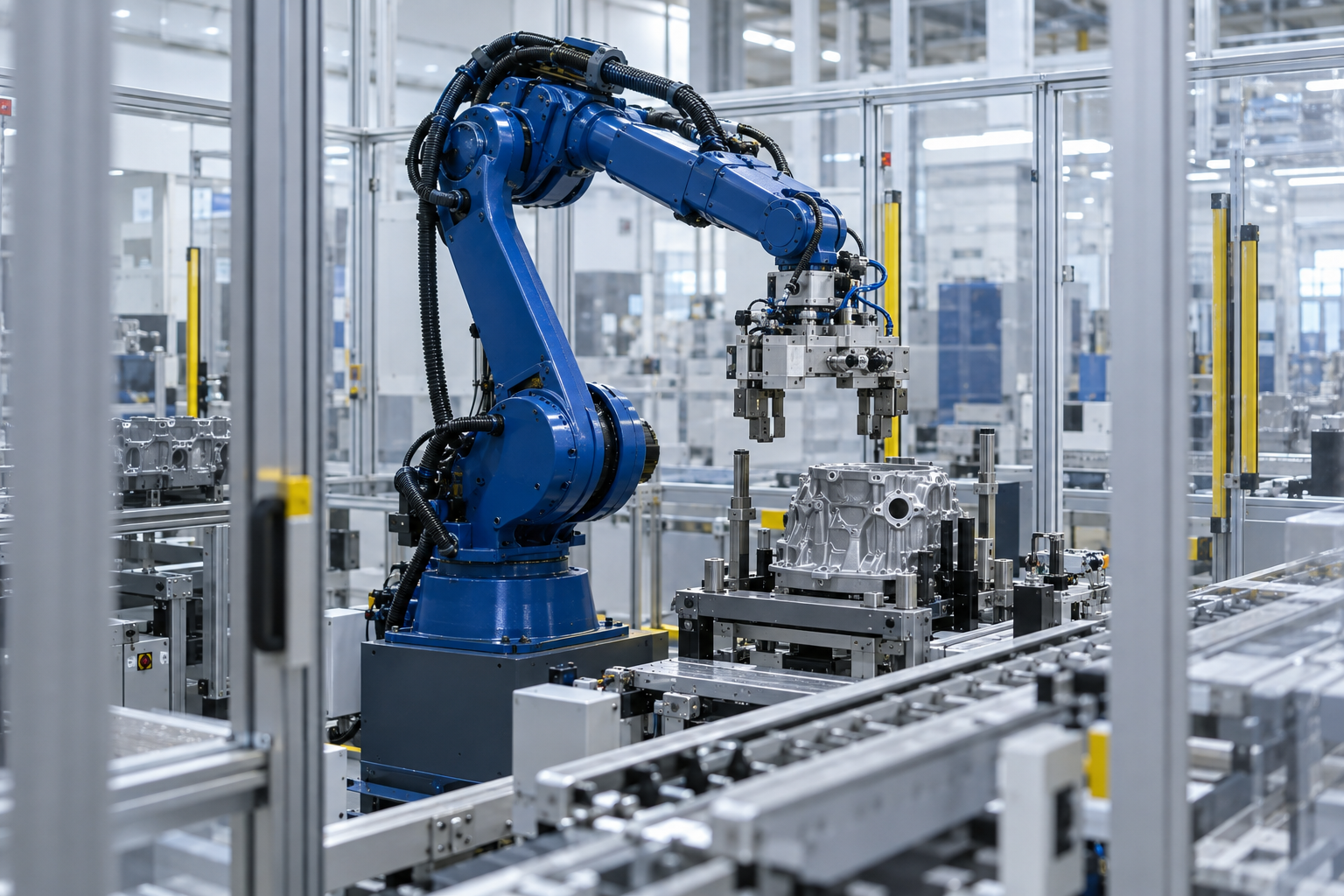
A reachable point does not establish a workable production cycle. We evaluate the agreed poses and sequence with the complete tool and part, then identify the constraints that affect your next design decision.
Check the approach, working position and retreat at each station. A robot may reach the part center yet run out of wrist travel when the tool rotates into position.
Follow the part and gripper through the transfer. Identify where a fixture, open clamp or guard limits the path, then compare a revised robot base or fixture position.
Estimate robot travel alongside clamp motion, process dwell and handshakes. Separate steps that can overlap from those that make the next station wait.
We agree on the stations, part variants, layout alternatives and outputs when we scope the study.
Annotated views identify the affected pose, obstruction or clearance and the change your team can evaluate.
See the estimated time for each step, the assumptions behind it and how it compares with your production target.
Compare the agreed layouts and identify which dimensions or equipment timings still need confirmation on the shop floor.
Tools and scope
Spinula uses Emulate3D for automation simulation and virtual commissioning, and SOLIDWORKS for related structural FEA of tooling. We select the modeling approach around the engineering question; a cell sequence study, a tooling load assessment and a controller-specific robot program require different inputs.
Offline programming can be scoped alongside robot simulation services when programs are part of the required handoff. Before accepting that scope, we confirm the robot model, controller version, software compatibility and program format. The proposal defines path preparation, sequence review and the calibration and validation work that remains on the real cell.
How we work
Agree on the cell revision, equipment, operating sequence and target. Identify missing geometry or timing data before modeling.
Review the agreed motions and layout alternatives. Keep model assumptions and supplier timing data visible when comparing results.
Discuss findings, layout changes and remaining physical checks. Additional variants, model delivery and program packages are defined in the proposal.
Start with the layout you have. Tell us which robot models or base locations you are comparing, and the decision your study must support.
Before you request a quote
No. Estimates depend on the modeled paths, motion settings, process times and equipment data. We document those assumptions and the checks needed during physical testing and commissioning.
No. Programs must match the agreed robot and controller configuration. Tool and frame verification, calibration, safety checks and validation on the installed equipment remain necessary before production.
Yes, within an agreed scope. Send the candidate models, available CAD and required poses. We confirm the appropriate tools and data before comparing reach, clearances and timing.
These are related but separate questions. Robot payload analysis evaluates load compatibility; virtual commissioning tests controls behavior. We can discuss combining the relevant studies in your proposal.
Engineering support across the US & Canada
Send the cell brief and your design review date, or call our engineering team in Jackson, Michigan.
1226 E McDevitt Ave
Jackson, MI 49203
Serving machine builders and automation integrators across the United States and Canada.
Findings apply to the agreed model and scenarios. Simulation supports engineering decisions; it does not replace physical validation or establish safety certification.